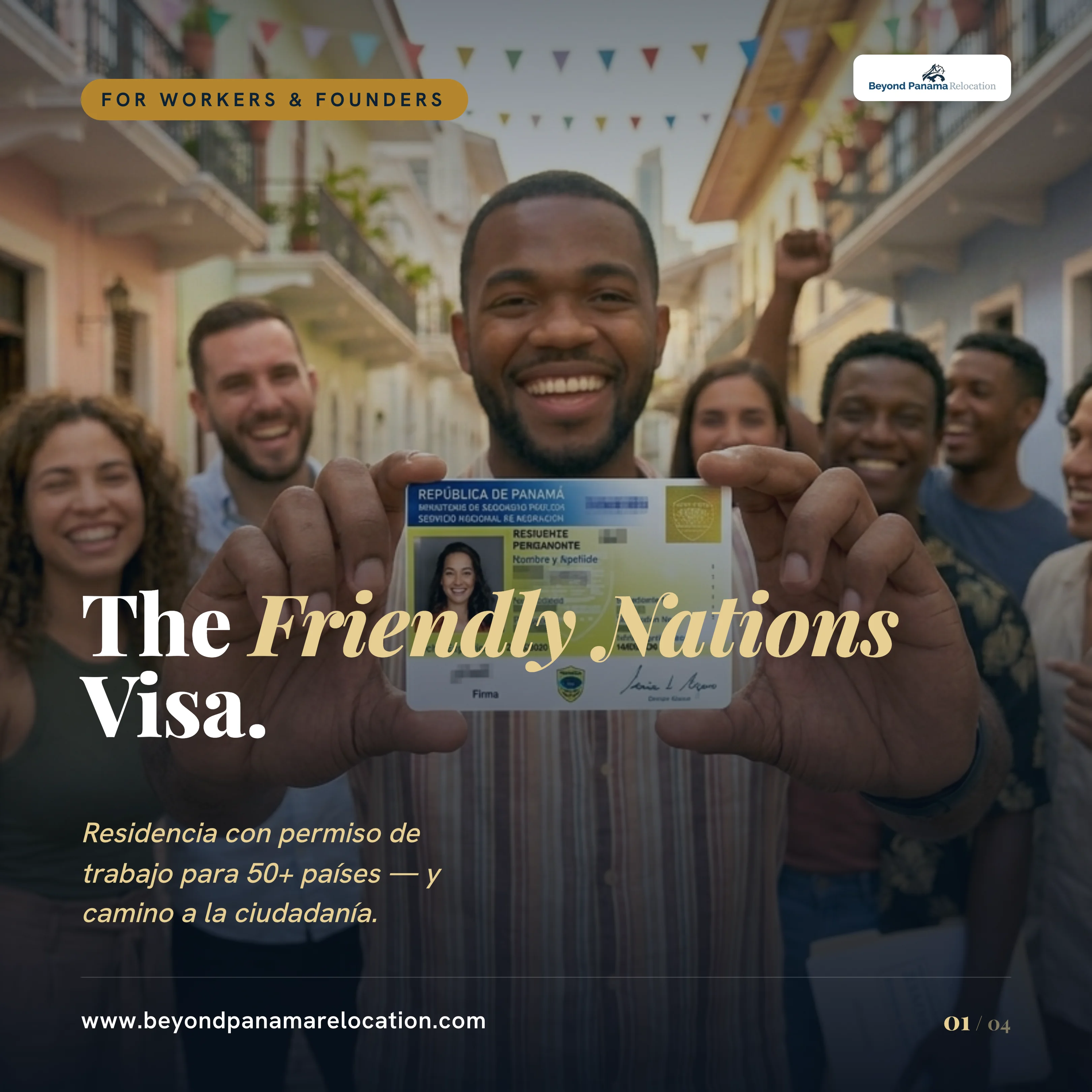
Panama Friendly Nations Visa: who qualifies and what it actually requires
A practical breakdown of the Friendly Nations Visa — which countries are included, what economic ties Panama requires, and what to expect from the application process.
The Panama Friendly Nations Visa is the fastest route to permanent residency for citizens of roughly 50 countries — but it’s also one of the most misunderstood. The name suggests it’s easy. The reality is that Panama requires proof of genuine economic ties to the country, and that requirement is taken seriously.
This guide explains exactly who qualifies, what those economic ties need to look like, and how the process works on the ground.
Which countries are eligible?
Panama maintains a list of “friendly nations” — countries deemed to have strong diplomatic, commercial, or professional ties with Panama. The list currently includes most OECD countries plus several Latin American, Asian, and Caribbean nations.
Countries on the list include: United States, Canada, United Kingdom, Germany, France, Spain, Italy, the Netherlands, Australia, Japan, South Korea, Argentina, Brazil, Chile, Colombia, Mexico, and dozens more. The full official list is published by Panama’s Ministry of Foreign Affairs and can change by executive decree.
A few things worth knowing:
- The list is not static. Countries have been added and removed over the years.
- Some countries that might seem like obvious inclusions are not on the list. If you are a citizen of a country not covered, you would need to look at other visa categories — Pensionado, Reforestation, or Self-Employed visas, depending on your situation.
- Dual citizens can choose which passport to use for the application. This matters if one of your nationalities is on the list and the other is not.
What the “economic ties” requirement actually means
This is where the Friendly Nations Visa is frequently misunderstood. The visa does not have a minimum income requirement — but it does require you to demonstrate a real economic connection to Panama. Panama’s immigration authority is looking for evidence that you are not simply obtaining residency as a paper exercise.
There are three ways to satisfy the economic ties requirement:
Option 1: Employment contract with a Panamanian company
You must have a labor contract with a legally registered Panamanian company, with the approval of Panama’s Ministry of Labor (MITRADEL). This means the company actually needs to sponsor you for a work permit alongside the residency application. This option works well for people transferred by multinational employers with operations in Panama, or those hired locally by a Panamanian employer.
Option 2: Ownership of a Panamanian legal entity
You can satisfy the requirement by owning or being a legal representative of a Panamanian corporation (usually an S.A. — Sociedad Anónima) or LLC that is actively doing business. “Actively doing business” is the operative phrase: a dormant shell company registered for asset holding does not satisfy this requirement. The company needs commercial activity, and immigration officers can ask for evidence.
Option 3: Ownership of real estate in Panama
Purchasing property in Panama — with a registered title or a right-of-possession title — satisfies the economic ties requirement. The property must be registered in your name in Panama’s Public Registry. There is no minimum purchase price in the regulations, but properties with a registered value well below market rate have drawn scrutiny. A legitimate residential purchase works.
Important: Before 2021, the Friendly Nations Visa existed in a simpler form with no documented economic ties requirement — it was essentially a nationality-based residency path. In 2021 it was briefly suspended amid concerns about abuse, then reinstated with stricter requirements. Older information about this visa may not reflect current rules.
What the process looks like
Documents you will need
The standard document package for a Friendly Nations Visa application includes:
- Valid passport (minimum 6 months of validity remaining)
- Criminal background check from your home country, apostilled
- Economic ties documentation (employment contract, corporate documents, or property title — whichever applies)
- Health certificate from a Panamanian doctor
- Passport-size photos
- Proof of payment of application fees
All documents issued outside Panama must be apostilled in the country of origin. Documents not in Spanish must be accompanied by a certified translation completed in Panama by a translator recognized by the Ministry of Foreign Affairs.
Processing time
Once submitted, the application typically takes 3 to 6 months to process. That timeline starts when the full, complete package is physically submitted to Panama’s National Immigration Service (Servicio Nacional de Migración). Incomplete submissions reset the clock.
During the review period, you will receive a temporary residence card (carnet provisional) that confirms you are in process. This card can be renewed while the application is pending.
What happens at approval
Unlike many other Panama residency categories, the Friendly Nations Visa grants permanent residence directly. There is no initial temporary period that converts to permanent after two or three years. Approval means permanent residence from day one.
No minimum stay requirement
Once you have permanent residence through the Friendly Nations Visa, Panama does not require a minimum number of days per year in the country to keep your status. This differs from some other residency programs globally. However, if you eventually pursue Panamanian citizenship, the rules are different.
Path to citizenship
Panamanian citizenship through naturalization requires 5 years of continuous residence. “Continuous” allows for reasonable international travel, but naturalization applicants need to demonstrate genuine ties and presence during that five-year period. The citizenship application is a separate, more demanding process.
The Friendly Nations Visa gives you permanent residence — which starts that five-year clock — but citizenship is not automatic at the five-year mark.
Friendly Nations vs. Pensionado Visa: key differences
| Factor | Friendly Nations | Pensionado |
|---|---|---|
| Income requirement | None | $1,000/month lifetime pension |
| Economic ties requirement | Yes (employment, business, or property) | No |
| Who it suits | Working-age adults, investors, property buyers | Retired individuals with pension income |
| Residency type granted | Permanent, directly | Permanent, directly |
| Pensioner discounts | No | Yes (25% restaurants, 15% healthcare, etc.) |
| Citizens of any country | No (list of ~50 countries applies) | Yes |
| Approximate processing time | 3–6 months | 3–6 months |
If you have a qualifying pension, the Pensionado Visa is simpler because it has no economic ties requirement. If you do not have a pension but you are a citizen of a Friendly Nation and can show economic ties, the Friendly Nations Visa is the more practical route.
Why working with a Panama immigration attorney matters
Panama’s immigration regulations change more frequently than official documentation reflects. Attorneys working in this space see what Immigration is actually accepting — including cases where the written rule and the practice at the counter differ. A document package accepted twelve months ago may now need something additional.
Beyond that: errors in an apostilled document, a translation that does not meet current format requirements, or corporate documents missing a required registration detail can cause the entire application to be returned. Starting over means losing months, not days.
Attorney fees for Friendly Nations Visa applications in Panama typically run $1,500 to $3,500 USD depending on the firm and case complexity, separate from government fees and document preparation costs.
This guide is for informational purposes only. Immigration requirements and procedures in Panama can change by decree without advance public notice. Always consult with a licensed immigration attorney in Panama before beginning any residency application.
Ready for the next step?
The quiz guides you in 2 minutes based on your real profile and budget.
Take the quiz →